
If a cable smokes, smells of burning or sparks, stop using the circuit. If it is safe to do so, cut the power at the appropriate point; do not go near the damaged section and get a qualified electrician to check it. In an active fire, the priority is to leave and call the fire department.
Why does a cable go from heat to burning?
Current passing through a conductor produces heat. Under its design conditions, a cable gives this heat to its surroundings; but if heat generation exceeds its dissipation, the conductor and insulation temperature rises. Prolonged heating can age the insulation and set the stage for the next failure.
A similar issue occurs at a connection point. A poor contact surface, a corroded connection or an incompatible terminal can create local resistance, so the cable end may burn while the rest of the run looks fine. A definite cause cannot be diagnosed from the shape of the burn alone.
Which causes need to be examined separately?
| Situation | Likely problem | What to check |
|---|---|---|
| Widespread heat along the route | Overload or insufficient heat dissipation | The real current, the installation method and correction factors |
| Burning near a terminal | Contact resistance or a faulty connection | Connection compatibility, the state of the cable end and the torque instructions |
| Damage where it passes an edge | Pressure or a cut in the sheath and insulation | Mechanical protection and the route it takes |
| The protective device trips repeatedly | A circuit fault, or a load or protection that does not match | Circuit testing and protection coordination |
These signs are for organizing the check and do not replace measurement and testing. A cable that does not suit the ambient temperature, contact with a hot surface, moisture in connections and proximity to flammable materials must also be recorded in the incident report.
Why isn't swapping the fuse for a higher rating a solution?
The job of protection is not just keeping the equipment on. The protective device must be coordinated with the wiring and the load and must disconnect a circuit fault in good time. Raising the rating to stop it tripping, without checking the cable and circuit, may remove the protection that is needed.
Overcurrent protection, earthing, shock protection and device-specific protection play different roles. Having one does not prove that all the connections are sound or that the design is right. A high-resistance connection also doesn't always appear as a high-current short circuit.
Reference for this section: Schneider Electric: principles of overcurrent protection
What do we do when we see smoke or smell burning?
- Stop using the suspect device or circuit and keep others away from the area.
- If the power cut-off point is sound and safe to reach, de-energize the circuit from there; do not touch the damaged cable to do this.
- In an active fire, don't use water, don't enter smoke, and don't go back into danger to save belongings.
- Before restarting, check the cause of the failure, the state of the adjacent route and whether the protection is suitable; replacing the burnt piece alone is not enough.
Reference for this section: London Fire Brigade: cable, fuse and plug safety
What information should we keep for prevention?
On a project, record the cable model, the length of the route, the installation method and the specifications of the protective device. A change of load, added equipment or a change in the cable route should lead to a fresh review; the earlier circuit is not necessarily suitable for the new load.
Assign a responsible person to periodically inspect connections and routes that are exposed to damage. If you need to order a replacement cable, a photo of the burnt part alone is not enough; also prepare the cable's specifications and the report on the cause of the failure. For the difference between normal and abnormal heat, read the .
Warning signs before a failure
Many heat-related failures are not sudden; there are signs beforehand. These signs are not a definite diagnosis, but they are reason enough for a qualified person to examine the circuit.
| Sign | Likely meaning | Safe action |
|---|---|---|
| A plug, socket or cable end getting too hot | Contact resistance, a loose connection or current above the circuit's limit | Stop using it and have an electrician check the connection. |
| Discoloration, softening or the smell of insulation | A temperature above the design limit | De-energize the circuit and find the cause before continuing. |
| Flickering lights or repeated power drops | An unstable connection or a high-loss route | Record when it happens and under what load, and report it. |
| The protective breaker trips repeatedly | Overload or a circuit fault | Find the cause; do not raise the breaker's rating. |
| A sparking or ticking sound | A loose connection or electric arcing | If it is safe, de-energize the circuit at the disconnect point. |
If you cannot explain a sign, don't assume it is "harmless". De-energizing the circuit and having a qualified person check it costs little compared with an accident.
Common installation mistakes that raise the risk
These items do not replace design and inspection; they are just a list of faults that appear often in failure reports.
- Using a cable that is too small for the circuit's real current.
- Not tightening the terminal properly, or not knowing the screw's tightening torque.
- Putting a stranded conductor under a terminal screw without a suitable ferrule.
- Covering or bundling heavily loaded routes without considering the effect of heat.
- Joining cable by a non-standard method, for example with tape alone.
- Squeezing or bending the cable where it passes over a sharp edge.
Before any change to a circuit, photograph the connection and the circuit label. That photo saves a lot of time when troubleshooting or ordering a replacement cable.
Frequently asked questions
Can a new cable catch fire too?
Yes; being new does not rule out an installation fault, mechanical damage, overload or an unsuitable choice.
Does flame-retardant mean the cable never burns?
No. Behavior in a flame-spread test differs from keeping the circuit working in a fire and from the safety of the whole installation.
Can the burnt part be repaired with insulating tape?
Restarting must come after de-energizing, finding the cause, and a repair or replacement that fits the standard and the manufacturer's instructions; covering up the burn mark is not a way of troubleshooting.
Products related to this topic
These products are presented for studying construction and specifications; they are not a size selection or an approval for use in a specific circuit.
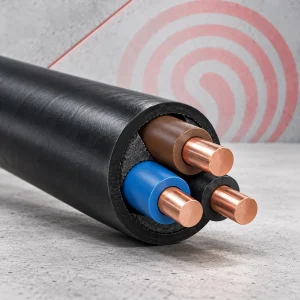
Underground cable 3x2.5 Khorasan Electric (Afsharnejad)
A multi-core underground cable sample for seeing the construction, insulation and sheath of a specific model.
490,000 toman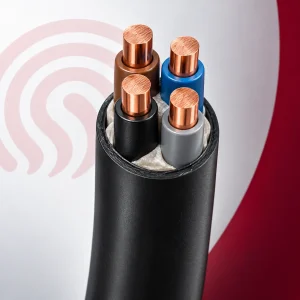
Underground cable 4x6 Khorasan Electric (Afsharnejad)
A sample from the same field for comparing construction, size and specifications.
1,355,000 toman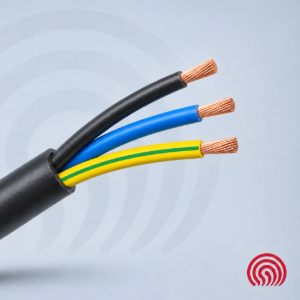
Flexible cable 3x2.5 Khorasan Electric (Afsharnejad)
A sample from the same field for comparing construction, size and specifications.
430,000 toman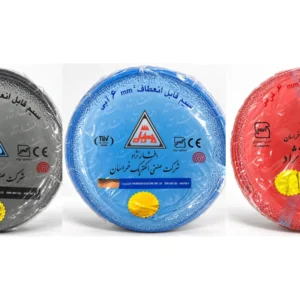
Flexible wire 6 Khorasan Electric (Afsharnejad)
A sample from the same field for comparing construction, size and specifications.
271,000 toman