
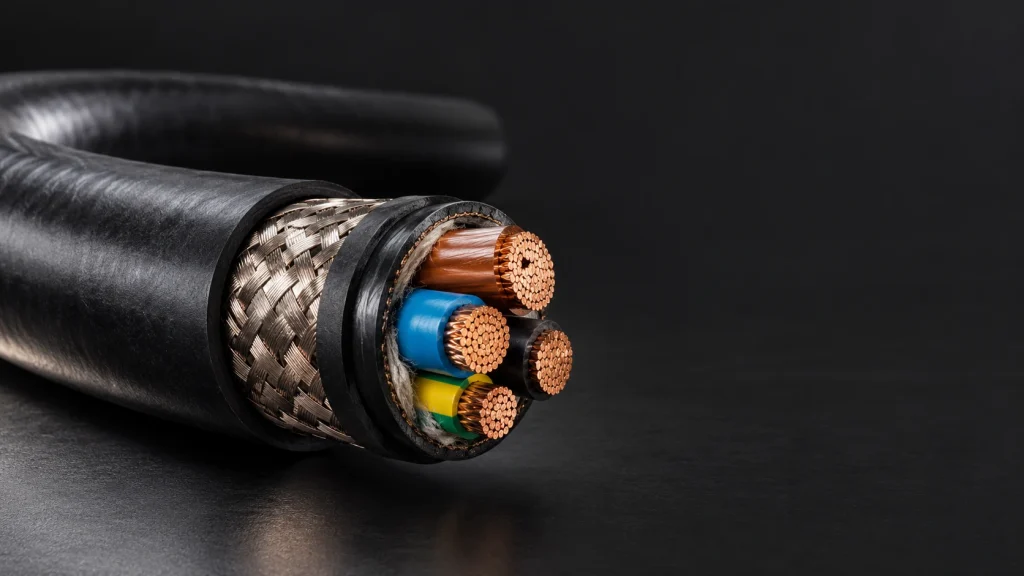
When comparing two cables, identify the layer that differs: conductor, core insulation, protective components or outer sheath. Brand, color and apparent thickness alone do not establish quality or suitability for a project. Reliable specifications come from the full product code, datasheet and test documents for that construction.
Copper, aluminum and CCA conductors
Conductor material affects electrical selection and termination. Do not assume copper and aluminum cables with the same cross-section are equivalent. Check current capacity, voltage drop, weight and connections against each cable's specifications. Terminals and connectors must suit the conductor material and construction. Follow the connector manufacturer's preparation and tightening instructions.
CCA means copper-clad aluminum and is not the same as an all-copper conductor. If a project specifies copper, a copper-colored surface does not demonstrate compliance. Verify the material in product specifications and reliable documentation; a photograph or surface color is not a material-composition test.
How do insulation and sheath differ?
Each core's insulation provides electrical separation. The outer sheath encloses the cable assembly and must suit its environment. They are not necessarily made from the same material. The term "PVC cable" can be ambiguous without a construction description; ask separately about insulation and sheath materials.
How should you compare PVC and XLPE?
PVC and XLPE are different materials used in cable construction. Compare complete models, declared temperature limits, rated voltage, installation conditions and manufacturer documentation. The name XLPE alone does not establish fire resistance, suitability for burial or resistance to every chemical environment.
A current-rating table applies to particular insulation and reference conditions. Do not transfer a table value to a cable with different insulation or installation conditions. Temperature limits of connections and equipment at both ends must also suit the wiring design.
Shielding, armor and double sheaths have different roles
| Feature | Selection question | What does it not establish on its own? |
|---|---|---|
| Shield | What signal and interference control are required? | Impact protection or suitability for burial |
| Armor | What mechanical protection does the design require? | Automatic substitution for a protective conductor or suitability for every environment |
| Double sheath | What are the exact construction and layer materials? | Suitability for immersion, fire resistance or continuous movement |
Distinguish the terms used for fire performance
Limiting flame spread, reducing smoke, halogen content and maintaining circuit operation during a fire are different properties. A marketing term such as "fireproof" is not a sufficient specification. Reliable documentation for the product must identify the test, scope, duration and conditions behind the claim. Project requirements determine which properties and evidence are needed.
Why weight or price alone does not prove quality
Total weight depends on the conductor, core count, insulation, sheath and other components. Comparing weights of different constructions does not establish conductor quality. Weight may flag a discrepancy against manufacturer data, but it does not replace testing and document checks. Compare price alongside specifications, sales unit, quotation date and supply terms.
Which documents should you request?
- A datasheet with the manufacturer and exact model code;
- Conductor material and construction, core count and cross-section;
- Rated voltage and insulation and sheath materials;
- Declared installation conditions and environmental limits;
- Test documentation relevant to the project's specific requirements;
- Product traceability and packaging information at delivery.
If a property is not documented, do not infer it from the family name or a shared image. Resolve unknown specifications before approving a substitute.