
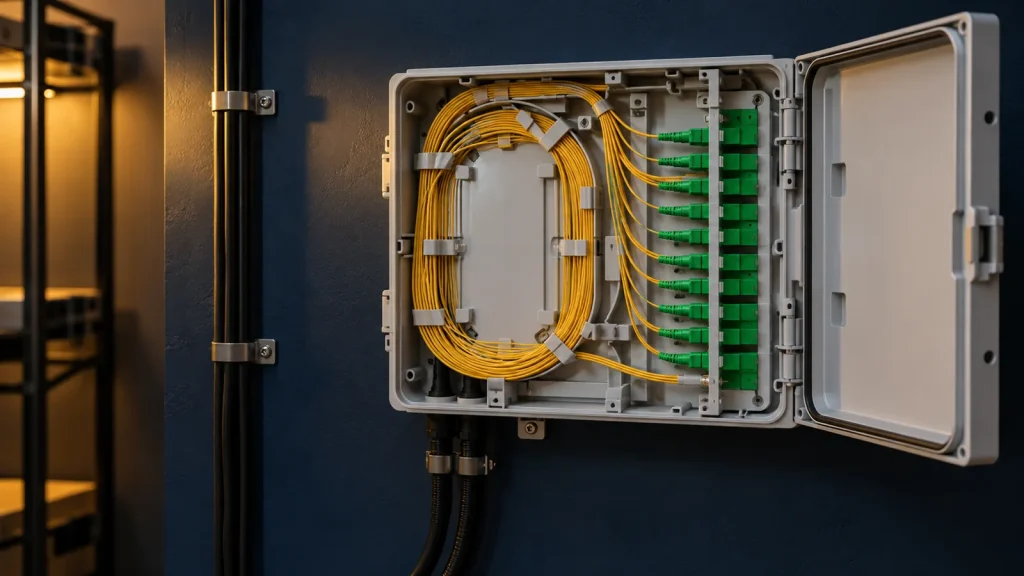
Fiber to the home is a set of cable, distribution, connection and testing. First clarify the operator's coverage and plan; then choose the building's equipment according to that plan.
Subject of the news: the Tanoma launch in Ordibehesht 1396 (April–May 2017).
Optical access to the subscriber's premises
Barad's archive piece describes the launch of the Telecommunication Company of Iran's FTTH project, named Tanoma. The stated aim was to expand optical access and offer services on it. The programs and service packages mentioned in the news belong to that period.
FTTH stands for Fiber to the Home: bringing optical fiber to the subscriber's premises. Such a connection is not limited to the incoming cable. Distribution points, splices and terminal equipment are also part of the path. In a passive optical network, or PON, a splitter shares the path among subscribers, and the connection at the subscriber's premises needs preparation and testing.
From a network news item to connecting one building
An announcement of network expansion in a city or province does not by itself say that a specific building receives service. For a new request, coverage at the address and the connection conditions must be asked of the provider.
After that, the number of units, the cable entry route and the distribution point inside the building become useful. The connector type and terminal equipment must also be compatible with the provider's network. It is better to prepare the purchase list after these are clear, so the items we buy match the real connection path.
When reviewing distribution items, also see the page on the ; the shape of the housing alone is not enough, and the split ratio and loss must match the design.
The connection path: from the operator's network to inside the unit
In a PON, the usual path runs from the operator's central equipment to the optical distribution network and then to the subscriber's terminal equipment. A splitter divides the optical power among its outputs; the split ratio and where it sits are part of the network design. Not every building necessarily has the same design or item list.
For the subscriber branch, see the family of . At the building's distribution point, the helps in understanding how fibers and splices are organized. The installation conditions and the capacity needed must be specified for the chosen model.
What information does a purchase list need?
| Project information | Why does it matter? |
|---|---|
| Number of units and the operator's plan | The distribution capacity and the number of connections are set from the actual need. |
| Entry route and approximate cable length | The installation environment, cable protection and order quantity become clear. |
| Connector type and end finish | The difference between SC and LC, or APC and UPC, must be matched to the equipment at both ends of the route. |
| Splitter location and loss budget | The split ratio is checked together with the cable and splice loss. |
| Test method and handover documents | The measurement result and the numbering of connections become traceable. |
Make the connection traceable before handover
Labeling fibers, recording the cable route and keeping the test result help in later troubleshooting. A lit indicator on the terminal equipment alone does not provide all the handover documents required. The type of test and acceptance limits must be set according to the design and the operator's requirements.
If you have questions about the role of testing, read the . To discuss the installation route, you can also start from the page on .
Frequently asked questions
Does the Tanoma news confirm current coverage for my building?
No. The news dates from 1396 (2017). Ask the current service provider about coverage at your address, connection conditions and accepted equipment.
Is any splitter suitable for any FTTH network?
The split ratio, loss, connector and compatibility with the operator's design must be checked. The name FTTH alone is not a sufficient criterion for choosing.
Can APC and UPC be connected directly to each other?
The end finish of the two connectors must be compatible. For a direct connection, do not use APC and UPC interchangeably; check the port and interface specifications.
Products related to this topic
These items show different parts of the route. The final purchase list and the compatibility of the models must be confirmed against the operator's plan and requirements.
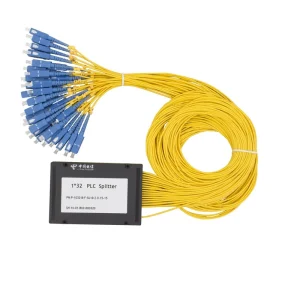
PLC box-type optical splitter
To get to know the PLC splitter; choose the split ratio and loss according to the operator's plan.
Price: ask sales