
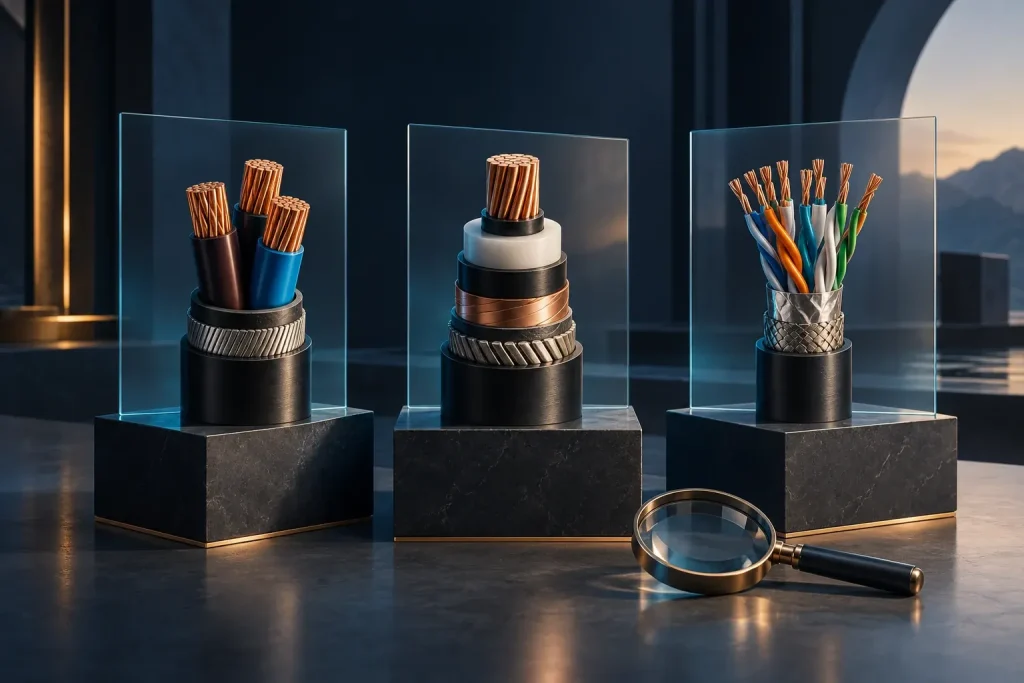
Which is better depends on the project's conditions. XLPE and PVC are names of materials; to decide we need to know which layer of the cable each is used in and what the full model's specifications are.
First settle whether we are talking about the insulation or the sheath
The insulation is the layer around the conductor and does the electrical separating. The outer sheath protects the assembly against the environment and defined stresses. A cable can have XLPE insulation and a PVC sheath; so the two words do not always describe two completely separate cables.
In a sales offer, ask for the full combination of layers: the conductor's material and class, the insulation, the protective components and the sheath. When it only says "XLPE cable", we still don't have a full answer about the sheath, armor, burial conditions or fire properties.
Reference for this section: Eland Cables: an example of cable with XLPE insulation and a PVC sheath
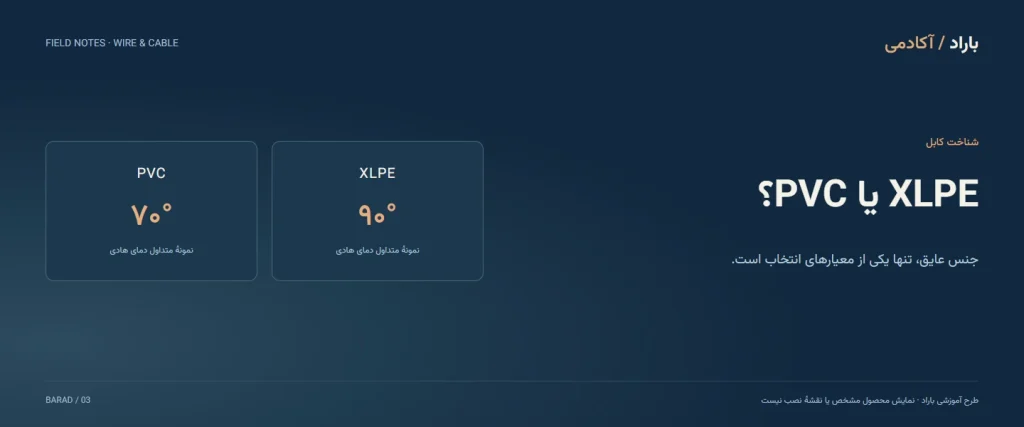
The main comparison of the two insulations
| Criterion | Ordinary PVC | Common XLPE |
|---|---|---|
| Nature of the material | Thermoplastic | Cross-linked polyethylene, thermoset |
| Usual continuous operating temperature of the conductor | 70 degrees Celsius in many ordinary types | 90 degrees Celsius in many power cables |
| Effect on design | Current capacity is read from the model's table and the installation method | Capacity may differ under reference conditions; needs a full match |
| Flexibility of the whole cable | Depends on the conductor construction and all the layers | Cannot be determined from the insulation name alone |
| Fire behavior | Checked against the product's standard and test | The name XLPE alone is not evidence of fire resistance |
The figures 70 and 90 degrees refer to the conductor temperature in common products; they are not the permitted touch temperature of the sheath or the permitted ambient temperature. Special PVC formulations can be configured differently; the data for the chosen model takes precedence over this general comparison.
Reference for this section: Eland Cables: conductor operating temperature and the differences between insulations
Can XLPE let you use a smaller cross-section?
A higher permitted insulation temperature may lead to a higher current capacity in a reference table, but choosing a cable is not only a thermal check. Voltage drop, short-circuit withstand, terminal limits and the installation method must also be checked. If another condition calls for a larger cross-section, changing the insulation alone does not remove it.
For this reason, a fixed percentage of current increase is not valid for all XLPE cables. Compare two models with the same conductor material, number of loaded conductors, installation method and environmental conditions. How to read the table is covered in the .
XLPE halogen-free and fire-resistant are not the same thing
Separate the type of insulation from the properties of the whole cable. A cable with XLPE insulation may have a PVC sheath. Also, reduced flame spread, low smoke, halogen-free and keeping the circuit working in a fire are different claims, and must be measured against the tests and classification for that same product.
On a project with fire requirements, don't ask the seller only for the name of the material; ask for the test standard, the classification and the model's documents. None of these properties makes a cable immune to damage from a poor connection or overload.
Match these five points before ordering
- Compare the model's rated voltage and standard with the project.
- Write the conductor's material, cross-section and class exactly.
- Specify the combination of insulation and sheath and whether armor or shield is needed.
- State the installation conditions, ambient temperature and limits of the connections.
- Check current capacity, voltage drop and protection for that model and route.
In a purchase list, the full description of the construction is more useful than an adjective such as "stronger". If a model substitution is needed, the datasheets of both options must be matched to the design before buying.
Reference for this section: Eland Cables: insulation material and thickness
Start the choice from the installation site
Instead of asking "which material is better?", write the site and the working conditions, and then ask the seller to propose a suitable model with documents.
| Conditions | What do we check? | What document do we ask for? |
|---|---|---|
| A public space, a tunnel or an escape route | The project's fire and smoke requirements | The classification and test standard of that model |
| A buried route or an outdoor duct | Mechanical protection, moisture and armor | The full layer construction and burial conditions |
| A high ambient temperature or a high continuous load | The conductor operating temperature and correction factors | The current capacity table for that model |
| A short route and a light load inside a building | Cost, connection compatibility and project requirements | Matching the specifications to the real need |
Common mistakes when comparing prices
Two prices are comparable when the cable construction is the same. Check these before comparing prices:
- The cross-section, core count and conductor class are the same in both offers.
- The armor, shield and sheath type are written in both offers.
- The words "XLPE" or "PVC" alone have not replaced the full specification.
- The length, packaging and shipping terms are equal.
Write the specifications of the two offers side by side in one table. If any cell stays empty, ask the seller about that cell.
Frequently asked questions
Is XLPE always softer?
No. The flexibility of the whole cable depends on the conductor, diameter, layers and the product's design; the insulation name is not enough.
Is PVC weak for every project?
No. A PVC cable that matches the need and design conditions can be a suitable choice; the use and the model's specifications decide.
Does a 90-degree rating mean the connections must also work at that temperature?
No. The thermal limits of the equipment and terminals must be observed separately.
Products related to this topic
These products are presented for studying construction and specifications; they are not a size selection or an approval for use in a specific circuit.
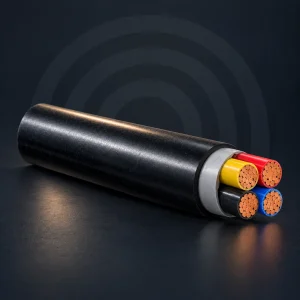
Underground cable 4x16 Khorasan Electric (Afsharnejad)
An underground cable sample for comparing construction with the models above.
3,430,000 toman