
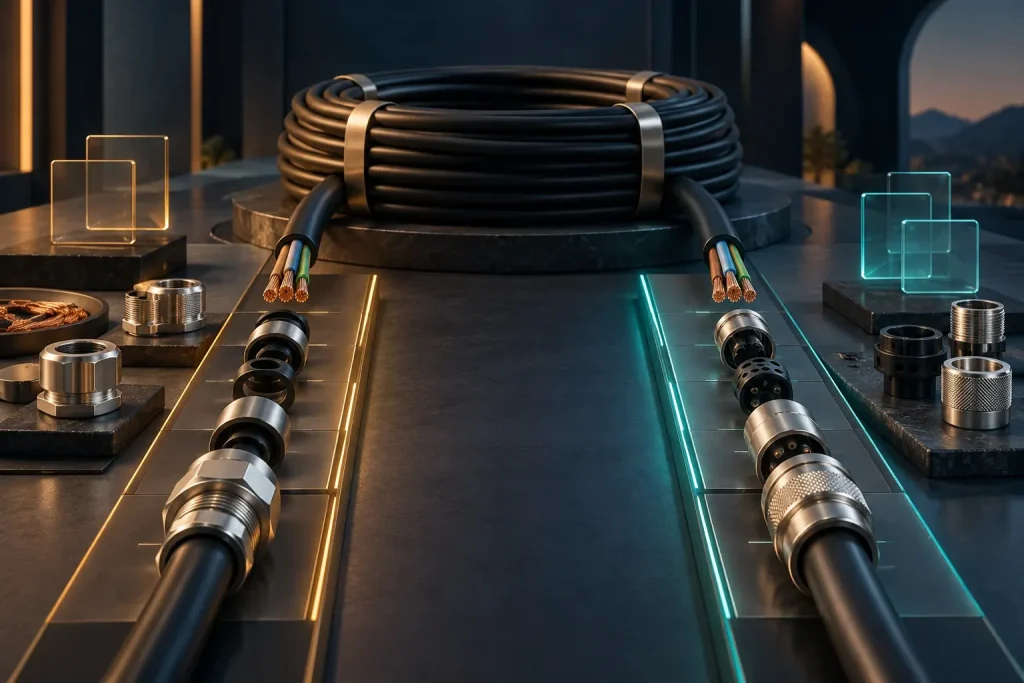
Don't choose an air conditioner cable size from the cooling capacity alone. First take the exact model and the supply circuit specifications from the manual and the nameplate, then check current, voltage drop, protection and the route's environment.
Why don't units of the same capacity necessarily have the same cable?
Cooling capacity is not the same quantity as input electrical power. Two units with a similar BTU may have different electrical specifications because of design, efficiency, compressor type and operating conditions. An "inverter" label does not replace the model's electrical information either.
If you tell the seller only the capacity or the phrase "air conditioner cable", an important part of the question is left unclear. Prepare the full names of the indoor and outdoor units, whether it is single-phase or three-phase, and where the power enters, along with a legible photo of the nameplate.
What do we read from the nameplate and the manual?
Note the voltage, number of phases, stated currents and protection requirements. In some manuals MCA refers to the minimum circuit ampacity, and the maker gives separate information for the fuse or protection. Read the term and how to use it from that same manual; don't generalize one number to all models.
In the Daikin manual sample in the sources, the supply and the communication between units are explained separately. This source is an example of how to read documents and is not a selection table for your air conditioner. In another model the supply may enter through a different unit, or the communication cable's specifications may differ.
Reference for this section: Daikin: a sample installation manual and the separation of supply and communication wiring
Don't confuse the supply cable with the cable between units
| Route | Information to take from the manual |
|---|---|
| From the panel to where the unit is supplied | The number of conductors, the protective conductor, the required capacity and the protection |
| Between the indoor and outdoor units | What each conductor does, its number, cross-section and length limit |
| The control or command route | The signal type, whether a shield is needed, or a cable specified by the maker |
| The part exposed to sun and moisture | The cable's permitted environmental conditions and how the route is protected |
Terminals that look alike, or the same number of wires, are no reason to swap them. Connecting the conductors, earthing and choosing protection must follow that model's diagram and the local rules.
The effect of route length and installation method
Two identical units with two different route lengths may need different voltage drop checks. A hot rooftop route, passing through conduit and a grouping of several circuits also affect the cable's capacity. Don't compare an amperage without reference conditions with the number on the nameplate.
The compressor's starting and the unit's momentary behavior must also be checked against the maker's documents. To understand the difference between a steady-state calculation and a starting condition, read the . A short cable does not remove the need for protection and a sound connection either.
A reviewable request for air conditioner cable
Instead of "I want a cable for a 24,000 air conditioner", complete the request like this: the exact model of the unit and its parts, a photo of the nameplate, the one-way route length, where the supply enters, the installation method, the ambient temperature and the specifications of the existing protection. Then ask the technical lead to check the final choice and its compatibility with the manual.
- Prepare the model information and the connection diagram.
- Check the current capacity after the installation factors.
- Check the route's voltage drop and the unit's special conditions.
- Order the confirmed cable and protection with the full code.
If a cable, plug or connection point heats up, continuing to use it or swapping the fuse on your own is not a solution. and check the circuit.
Information to note from the nameplate and the manual
Before an inquiry, take this information from the unit's nameplate or manual. If you haven't bought the unit yet, ask the unit's seller to write these same items.
The unit's model and capacity (for example 18,000 BTU) and the supply type: single-phase or three-phase.
The current or power on the nameplate; if "minimum circuit ampacity" or "maximum fuse" is written, note that.
The route length from the panel to the outdoor unit and the installation method: conduit, duct or surface.
Installation points that are often forgotten
- Connect the units' earthing according to the unit's instructions and the project's standard.
- Provide suitable, separate protection for the unit's circuit.
- Seal where the cable enters the terminal and passes through a wall, and protect it from mechanical damage.
- Don't confuse the supply cable with the communication cable between units, and follow the unit's manual.
- After installation, record the cable model and route length for future repairs.
Frequently asked questions
What size is definite for an 18,000 air conditioner?
Without the model, the electrical specifications and the route conditions, no definite answer can be relied on. The cooling capacity alone is not enough.
Does a thicker cable always solve the problem?
A connection fault, mismatched protection or a wiring error is not necessarily fixed by enlarging the cable.
Should we buy an evaporative cooler cable for an air conditioner?
The market name of a product is not a basis for matching; the number of conductors, the construction and the specifications each unit needs must be set from its documents.
Products related to this topic
These products are presented for studying construction and specifications; they are not a size selection or an approval for use in a specific circuit.
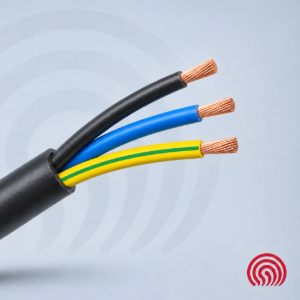
Flexible cable 3x2.5 Khorasan Electric (Afsharnejad)
A single-phase three-core cable sample; check the nameplate current and the route length.
430,000 tomanFlexible cable 3x4 Khorasan Electric (Afsharnejad)
A larger cross-section for longer routes or higher current.
660,000 toman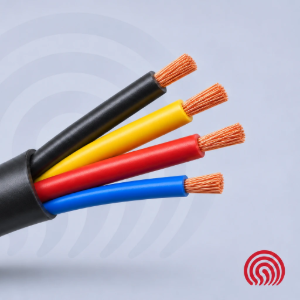
Flexible cable 4x2.5 Khorasan Electric (Afsharnejad)
A four-core sample for three-phase equipment, after matching it to the nameplate.
554,000 tomanFlexible cable 3x1.5 Khorasan Electric (Afsharnejad)
A sample from the same field for comparing construction, size and specifications.
266,000 toman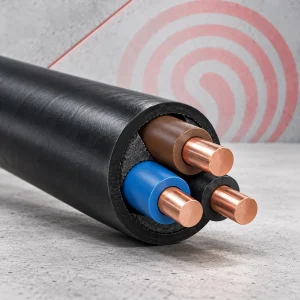
Underground cable 3x2.5 Khorasan Electric (Afsharnejad)
A sample from the same field for comparing construction, size and specifications.
490,000 toman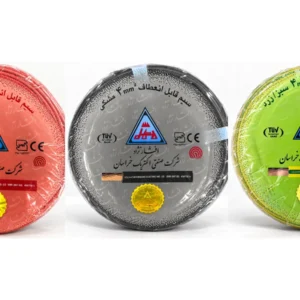
Flexible wire 4 Khorasan Electric (Afsharnejad)
A sample from the same field for comparing construction, size and specifications.
183,000 toman