

To estimate shipping, take the full weight of that same model from the datasheet. Calculating the copper weight does not give the total cable weight, and being light or heavy does not by itself prove a product's conformity.
Reading the units in a cable weight table correctly
Cable weight is usually expressed as mass per unit length, for example kilograms per kilometer or kilograms per meter. A number like 136 in the kg/km column means the approximate mass of each kilometer of cable is 136 kilograms; for each meter, divide it by one thousand.
In ordering and shipping, keep the net weight of the cable separate from the gross weight with the reel, packaging and other items. If the length of each package is unknown, comparing the weight of two coils gives no reliable information about the quantity or construction of the cable.
Mass (kg) = Length (m) × (kg/km) ÷ 1000
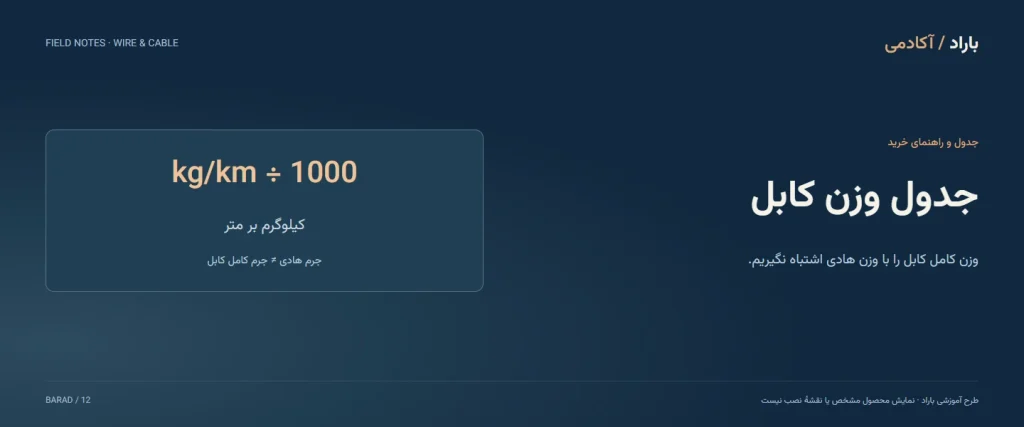
Table of approximate weights for specific Afsharnejad models
The data below is read from the specifications of Barad's current models and the document links for the same product. The weight is for the whole cable without the reel, in kilograms per kilometer; the per-100-meter column is calculated from the same figure. Don't generalize these samples to another brand, family or size.
| Model and family | Kilograms per kilometer | Kilograms per 100 meters | Source for the same size |
|---|---|---|---|
| Flexible cable 2x1.5 Afsharnejad Khorasan NYMHY | 88 | 8.8 | Datasheet ↗ |
| Flexible cable 2x2.5 Afsharnejad Khorasan NYMHY | 136 | 13.6 | Datasheet ↗ |
| Flexible cable 3x1.5 Afsharnejad Khorasan NYMHY | 110 | 11 | Datasheet ↗ |
| Flexible cable 3x2.5 Afsharnejad Khorasan NYMHY | 162 | 16.2 | Datasheet ↗ |
| Flexible cable 3x4 Afsharnejad Khorasan NYMHY | 229.45 | 22.945 | Datasheet ↗ |
| Flexible cable 4x2.5 Afsharnejad Khorasan NYMHY | 207 | 20.7 | Datasheet ↗ |
| Flexible cable 4x4 Afsharnejad Khorasan NYMHY | 300 | 30 | Datasheet ↗ |
| Underground cable 4x16 Afsharnejad Khorasan NYY-O | 1065 | 106.5 | Datasheet ↗ |
Flexible, underground and shielded cables can have different weights with the same number of strands and cross-section, because the layers, materials and construction are not the same. If the page data differs from the manufacturer's newer datasheet, ask about the version and specifications of that same shipment for the final order.
A sample calculation of an order's weight
If a model's datasheet gives an approximate weight of 136 kilograms per kilometer, then 250 meters of that same model has a cable mass of about 34 kilograms. The weight of the reel and packaging is not added to this calculation.
This conversion depends only on the length and the mass per unit length; it is not confirmation of the delivered length or the cable's quality. To plan shipping, besides the weight, ask the seller for the package or reel dimensions, how it can be handled and the unloading conditions. Don't write the approximate catalog figure in place of a final weighed number.
How do we separate the copper weight from the full weight?
For a simple, straight copper conductor, the mass can be estimated from density and volume. Using an approximate density of 8.9 grams per cubic centimeter, the result for n conductors of equal cross-section A, in square millimeters, takes the following form:
For example, for three conductors with a hypothetical cross-section of 2.5 square millimeters, the idealized estimate is about 66.75 kilograms per kilometer. This number is only the copper of a simple calculation model; it excludes the insulation, sheath, lay-up twist, shield and other components and is not the catalog weight of a 3x2.5 cable.
Reference for this section: Copper Development Association: density of C11000 copper
Don't confuse the copper index and quality testing with weight
Besides the cable weight, a manufacturer may declare a copper index for commercial calculations. The definition and method of this index must be read from that same manufacturer; don't arbitrarily treat it as the real net copper weight or the total cable weight. LAPP likewise presents the copper index as a calculation quantity in kg/km.
Also, the nominal cross-section is not a label for a simple weight calculation. Conductor resistance and the product's other requirements matter in assessing conformity. A claim that a cable is or isn't to standard cannot be proven by comparing the weight of two samples alone.
Reference for this section: LAPP: the definition of the copper index and how it differs from cable weight
Example: the weight of an order and its coils
If you know the approximate weight of the cable, you can easily estimate the weight of an order. The number below is hypothetical and only shows the method of calculation.
Hypothetical cable weight: 180 kilograms per kilometer. Order quantity: 1,200 meters, that is 1.2 kilometers.
Total cable weight: 1.2 × 180 = 216 kilograms.
If the cable comes in 100-meter coils, each coil is about 18 kilograms.
The weight of packaging, reel or pallet is added to this number and must be asked about separately from the seller.
Common mistakes when using a weight table
- Confusing kilograms per kilometer with kilograms per meter; to convert, divide or multiply by 1,000.
- Treating the full cable weight as equal to the weight of the conductor copper.
- Forgetting the packaging, reel and pallet in the shipping estimate.
- Treating the table weight as an exact value; weights are approximate and carry manufacturing tolerance.
For crane capacity, transport or loading, get the declared weight of the package from the seller and have the person responsible for transport set the safety factor.
Frequently asked questions
Is a heavier cable necessarily better?
No. More weight may come from the sheath, armor or a different construction. Compare models and documents with the same construction.
Does the table weight include the reel?
The table in this article shows the approximate mass of the cable. The weight of the reel and packaging must be obtained separately.
Can the weight of all cables of the same size be worked out from the weight of one cable?
No. The brand, conductor material, number of strands, insulation and protective layers must be specified.
Products related to this topic
These products are presented for studying construction and specifications; they are not a size selection or an approval for use in a specific circuit.
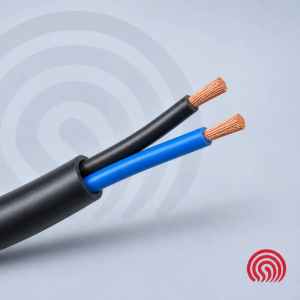
Flexible cable 2x2.5 Khorasan Electric (Afsharnejad)
The specifications of the sample model in the weight table and a link to its datasheet.
303,000 toman
Underground cable 4x16 Khorasan Electric (Afsharnejad)
A sample from the underground family; for weight comparison, use only the exact construction of that same model.
3,430,000 toman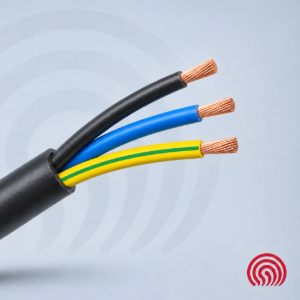
Flexible cable 3x2.5 Khorasan Electric (Afsharnejad)
A sample from the same field for comparing construction, size and specifications.
430,000 toman
Evaporative cooler cable 4x1.5 Khorasan Electric (Afsharnejad)
A sample from the same field for comparing construction, size and specifications.
361,000 toman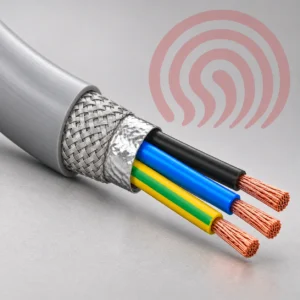
Shielded flexible cable 3x2.5 Khorasan Electric (Afsharnejad)
A sample from the same field for comparing construction, size and specifications.
530,000 toman
Flexible wire 6 Khorasan Electric (Afsharnejad)
A sample from the same field for comparing construction, size and specifications.
271,000 toman