
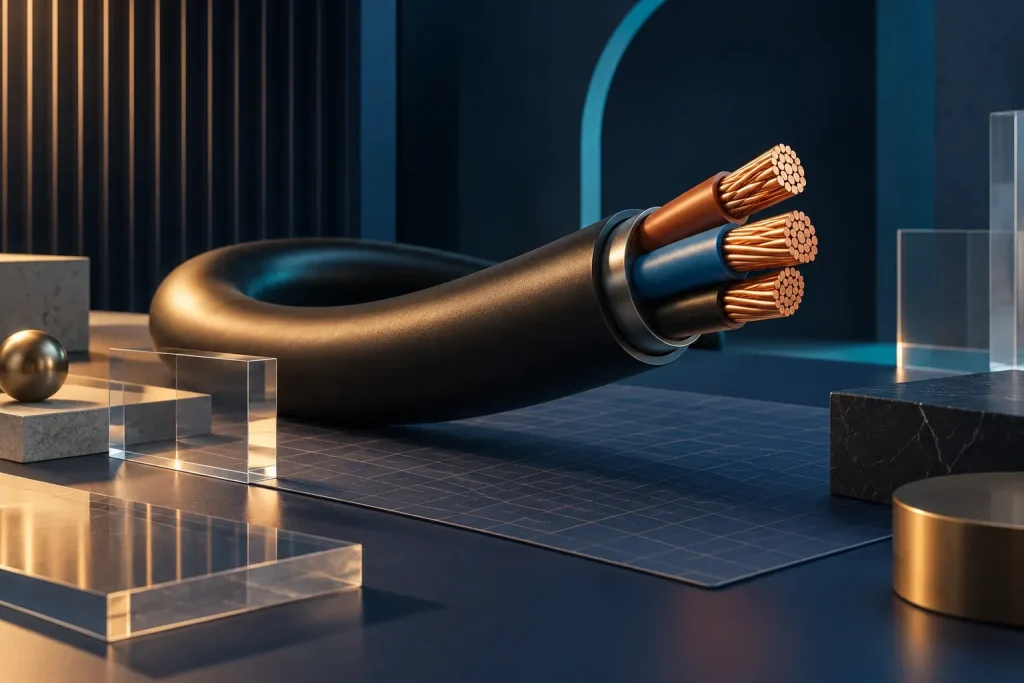
Being flexible relates to the conductor's construction; it doesn't by itself determine current capacity, water resistance or suitability for continuous movement. The product's full specifications must be matched to where it is used.
A cable's core is different from a conductor's strand
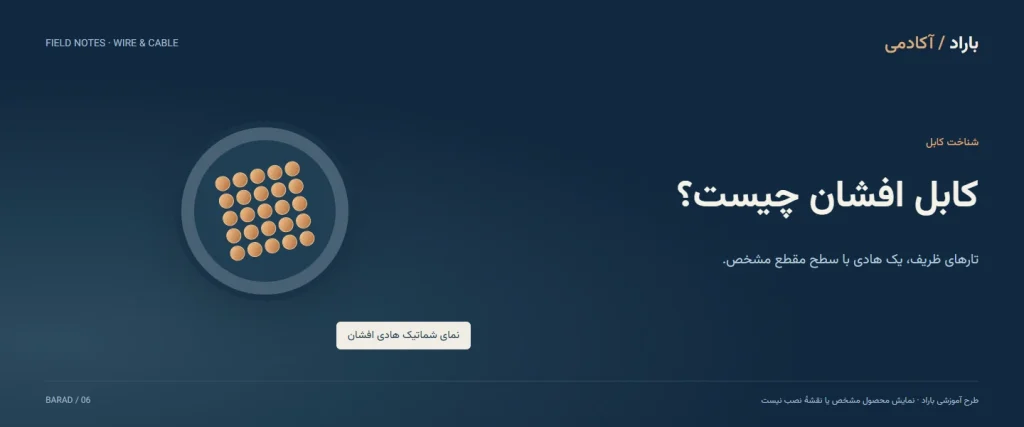
In flexible cable, each conductor is made of a number of thinner wires. These strands together make a conductor with a stated nominal cross-section, and the insulation separates it from the other conductors. Many ordinary flexible cables have a Class 5 conductor; Class 6 also exists for greater flexibility.
In purchasing terms, "three-core" usually describes the number of insulated conductors, not the number of copper strands inside each conductor. In a 3 by 2.5 cable we have three conductors, each with a nominal cross-section of 2.5 mm²; their total should not be treated as the cross-section of each core.
Reference for this section: Eland Cables: conductor construction and classes 1, 2, 5 and 6
Telling flexible semi-flexible and solid apart
| Conductor construction | Main feature | Selection note |
|---|---|---|
| Class 1: solid | One wire in each conductor | Common in fixed installation; the product model decides |
| Class 2: stranded | Several wires in a rigid conductor construction | Semi-flexible does not mean a cable for continuous movement |
| Class 5: flexible | Finer strands and more flexibility | Read the bending limits and the use from the datasheet |
| Class 6: extra flexible | A more flexible construction | The properties of the whole cable still need to be checked |
A conductor class is not an overall grade of a cable's quality or safety. A Class 5 cable that doesn't suit the environment is no better than a correctly chosen fixed-installation cable. The IEC 60228 standard covers conductor specifications, including the nominal cross-section and resistance; the final use must be stated in the standard and datasheet for that cable type.
Reference for this section: IEC 60228:2023: introduction to the standard for conductors of insulated cables
Where is flexible cable used?
Flexible cables are offered in many models for equipment, control and some flexible connections. Each model has its own voltage, temperature and permitted environment. For example, the H05VV-F datasheet mentioned in the sources describes a light general-purpose use with PVC insulation and sheath, and is not presented as suitable for every industrial or outdoor environment.
So the title "flexible" is not enough to choose a cable for contact with water, oil, sunlight, pulling or continuous movement. These properties must have been confirmed for that model. Don't put a general soft cable in the place of an elevator travelling cable or a drag-chain cable simply because it bends easily.
Reference for this section: Eland Cables: the H05VV-F flexible cable datasheet and its limits of use
Why is connection quality important with flexible cable?
A connection must be able to hold all the conductor's strands in a defined way. Choosing a ferrule or lug, the stripping length and the tightening torque depend on the terminal type and its instructions. Cutting some of the strands or putting an unsuitable connection under the screw can change the effective contact area.
No single rule such as "all conductors must be tinned" or "every terminal needs a ferrule" can be drawn from this. The terminal's maker and the project's conditions decide the preparation method, and the connection must be made on a de-energized circuit.
A sample of reading and writing an order
The phrase "copper flexible cable, three by two and a half" clarifies part of an order, but the model, voltage, the presence of a protective conductor, the sheath material and the environment of use must still be specified. The color of the outer sheath alone does not answer these questions.
- Write the number of conductors and the nominal cross-section of each conductor separately.
- Ask for the conductor class and material and the insulation and sheath specifications from the model's datasheet.
- State clearly whether the use is fixed, occasional flexing or continuous movement.
- Match the length, packaging and the need for a protective conductor to the design.
On the You can see the construction of the available models. To decide on a size, reading about and is needed; being soft does not replace those two checks.
Terminating flexible cable: ferrules and terminals
The fine strands of a flexible conductor may spread or be crushed under a terminal screw's pressure and leave a loose connection. To reduce this risk, use a suitable ferrule or cable end and a crimping tool compatible with it.
- The ferrule's cross-section must match the conductor's cross-section.
- Crimping must be done with the tool and die made for that ferrule.
- The destination terminal must be rated for a flexible or ferruled conductor.
- Inspect the connection visually after crimping, and no strand should stick out.
Many screw-terminal instructions do not recommend soldering the end of a conductor. The terminal maker's instructions and the project's standard are the reference.
What does greater flexibility mean? Bend radius and type of movement
Being flexible doesn't mean unlimited bending. Every model has a minimum bend radius, and it must be read from that model's datasheet.
More important than that is the type of work: fixed installation, occasional movement and continuous movement are not the same. For continuous movement, for example inside a cable chain, a model made for that use is needed, and not every flexible cable is suitable.
Frequently asked questions
Is flexible the same as multi-core cable?
No. Multi-core refers to the number of insulated conductors; flexible describes the construction of strands inside each conductor.
Is every flexible cable suitable for outdoor installation?
No; environmental resistance, the sheath and the permitted use must be stated for that model.
Is a cable with more strands more standard?
The number of strands alone is not enough. The conductor's resistance, construction, dimensions and the model's other requirements must be checked.
Products related to this topic
These products are presented for studying construction and specifications; they are not a size selection or an approval for use in a specific circuit.
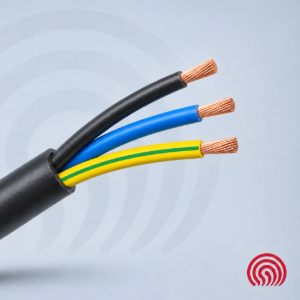
Flexible cable 3x2.5 Khorasan Electric (Afsharnejad)
A multi-core cable sample for seeing the conductor class, insulation and specifications of that model.
430,000 toman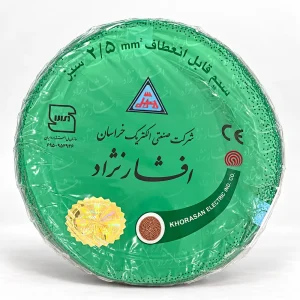
Flexible wire 2.5 Khorasan Electric (Afsharnejad)
A single-core flexible wire sample; to tell wire apart from multi-core cable.
116,500 toman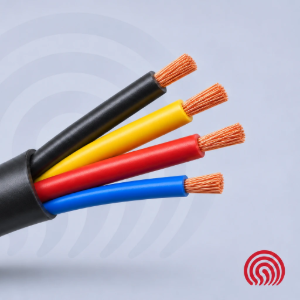
Flexible cable 4x2.5 Khorasan Electric (Afsharnejad)
A sample from the same field for comparing construction, size and specifications.
554,000 toman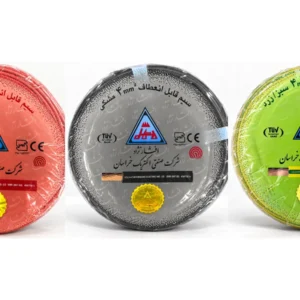
Flexible wire 4 Khorasan Electric (Afsharnejad)
A sample from the same field for comparing construction, size and specifications.
183,000 toman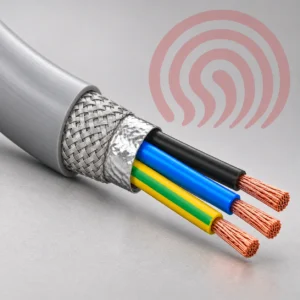
Shielded flexible cable 3x1.5 Khorasan Electric (Afsharnejad)
A sample from the same field for comparing construction, size and specifications.
350,000 tomanFlexible cable 3x4 Khorasan Electric (Afsharnejad)
A sample from the same field for comparing construction, size and specifications.
660,000 toman