
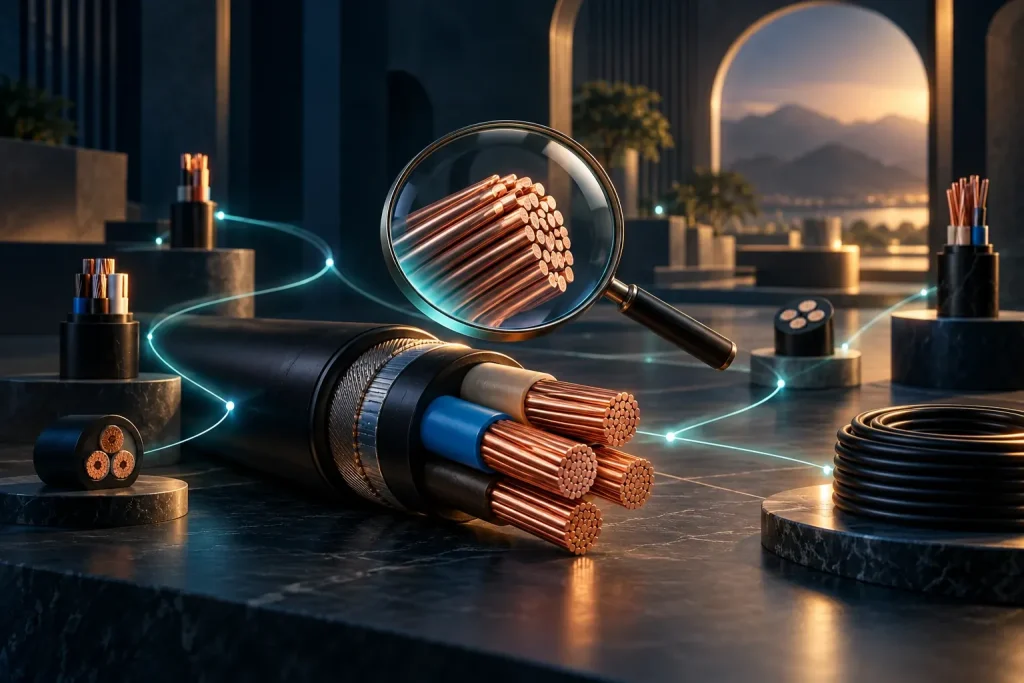
You can't give a definite verdict on a cable's health by touching it. A burning smell, discoloration, unusual softening of the sheath, a noise or sparks are signs to stop use and check the circuit; don't treat these signs as normal.
Does every warm-up mean a fault?
A cable produces some heat when current passes through it, but whether the temperature is permitted isn't decided by the feel of a hand. The conductor's temperature differs from the temperature on the sheath, and the permitted range depends on the construction and installation conditions. Also, measuring the surface temperature alone does not show the exact temperature of all layers or the state of a hidden connection.
This article is a way of sorting troubleshooting questions, not permission to keep running a hot circuit. If the heat is new or rising, the load or installation conditions may have changed. A smell, noise, smoke or visible damage makes the need to stop use and have the technical lead check more serious.
Reference for this section: Electrical Safety First: danger signs in electrical equipment
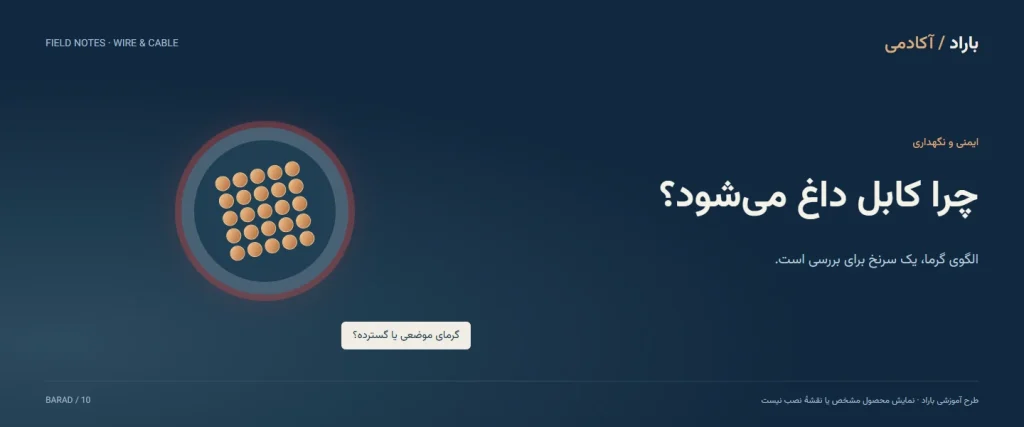
What does the place where it heats up tell us?
| Observed pattern | Possibilities to check |
|---|---|
| More heat at the connection end | Contact resistance, an unsuitable terminal or connection damage |
| Widespread heat along the cable | Load, thermal capacity and heat dissipation |
| More heat in a coiled or enclosed section | Poorer ventilation or heat buildup |
| Heat together with the device malfunctioning | The state of the load, the supply and the device itself |
| More heat after a change in consumption | A higher load or a change in the operating pattern |
Several causes can exist at once. For example, a higher load can expose an already poor connection sooner. That is why replacing the cable without checking the connections, or tightening a screw without measuring the current, does not necessarily solve the problem.
Why do contact resistance and current matter?
In a simple resistive model, heating power varies as P = I²R. If the resistance stays constant and the current doubles, the heat produced quadruples. This relation helps explain the effect of overload, but it does not by itself calculate a cable's permitted capacity.
At a faulty connection, local resistance can produce considerable heat. A high ambient temperature and poor route conditions also limit heat dissipation. The real behavior of the insulation, connection, load and protection must be reviewed together; "thicker copper" is not the definitive answer for all these cases.
Does voltage drop always increase current?
No. The behavior of the load matters. With a constant resistive load, a lower voltage behaves differently than with some motor loads or controlled loads. In a motor, the load and starting conditions are decisive too. So don't use the blanket statement "voltage drop always heats the cable."
For diagnosis, the current, voltage and the device's operating state must be recorded under relevant conditions. These measurements on a live circuit are work for a trained person. You can read how to separate route drop from the state of the supply in the .
What report should we give the electrician or the maintenance person?
- Say when the heat appeared and after what change.
- Record the name and model of the load, the operating time and simultaneous loads.
- Describe the location of the heat and any visible signs without touching the dangerous part.
- Prepare the cable specifications, route and protection from the available documents.
- Before using it again, get the result of the cause review and the corrective action.
Replacing the breaker with a higher-amperage one or adding a new adapter is not troubleshooting. If the signs are close to burning, and its safe actions.
Reference for this section: London Fire Brigade: cable, fuse and plug safety
A useful report for the electrician or maintenance person
The more precise the information, the faster and cheaper it is to find the cause. Without touching the hot part, note these items:
- When and under what conditions it occurs, for example when which device is switched on.
- The exact place that heats up: mid-route, terminal, plug or socket.
- The cable model and cross-section, the route length and the installation method.
- The current or power of the load, if it has been measured with a suitable instrument.
- The type and rating of the protective device, and photos of the route and the connections.
A simple periodic inspection
Regular inspection prevents many problems, but work on a live circuit must be done only by a trained person.
- Look at connections and terminals for discoloration, looseness or the smell of insulation.
- Check that no new load has been added to the circuit.
- Keep the ventilation of the panel or route free of dust and obstructions.
- Record the inspection date and the findings.
Measuring the surface or connection temperature must be done with a suitable instrument by a trained person; interpret the number against the specifications of that model and the load conditions.
Frequently asked questions
Can you tell by hand whether the temperature is permitted?
No. Touching is dangerous, and it is not a valid way to judge a conductor's thermal state.
If the breaker doesn't trip, is the circuit sound?
A protective device not tripping does not prove that all the connections are sound or that the cable is suitable.
Does a coiled cable behave the same as an uncoiled one?
Heat dissipation conditions differ. The limits set by the cable or reel maker and the state of the load must be observed.
Products related to this topic
These products are presented for studying construction and specifications; they are not a size selection or an approval for use in a specific circuit.
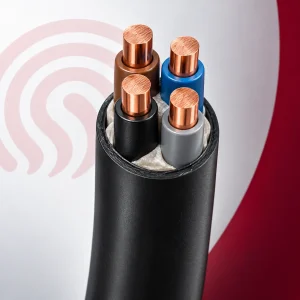
Underground cable 4x6 Khorasan Electric (Afsharnejad)
If troubleshooting shows the cross-section was unsuitable, review the replacement model against its documents.
1,355,000 toman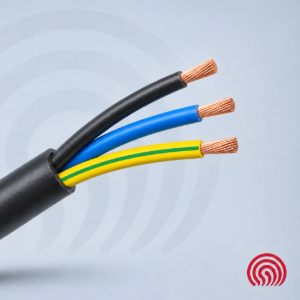
Flexible cable 3x4 Khorasan Electric (Afsharnejad)
A larger cross-section sample for comparison with the current model.
660,000 toman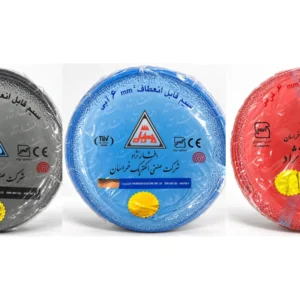
Flexible wire 6 Khorasan Electric (Afsharnejad)
A single-core wire sample; to tell wire apart from multi-core cable.
271,000 toman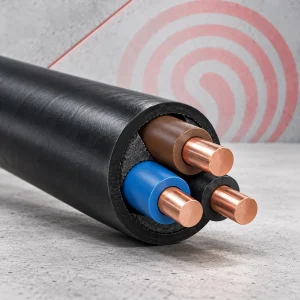
Underground cable 3x2.5 Khorasan Electric (Afsharnejad)
A sample from the same field for comparing construction, size and specifications.
490,000 toman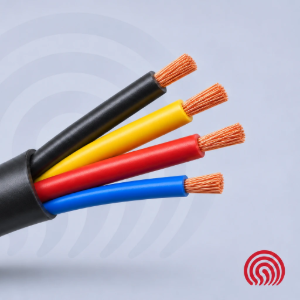
Flexible cable 4x2.5 Khorasan Electric (Afsharnejad)
A sample from the same field for comparing construction, size and specifications.
554,000 toman