
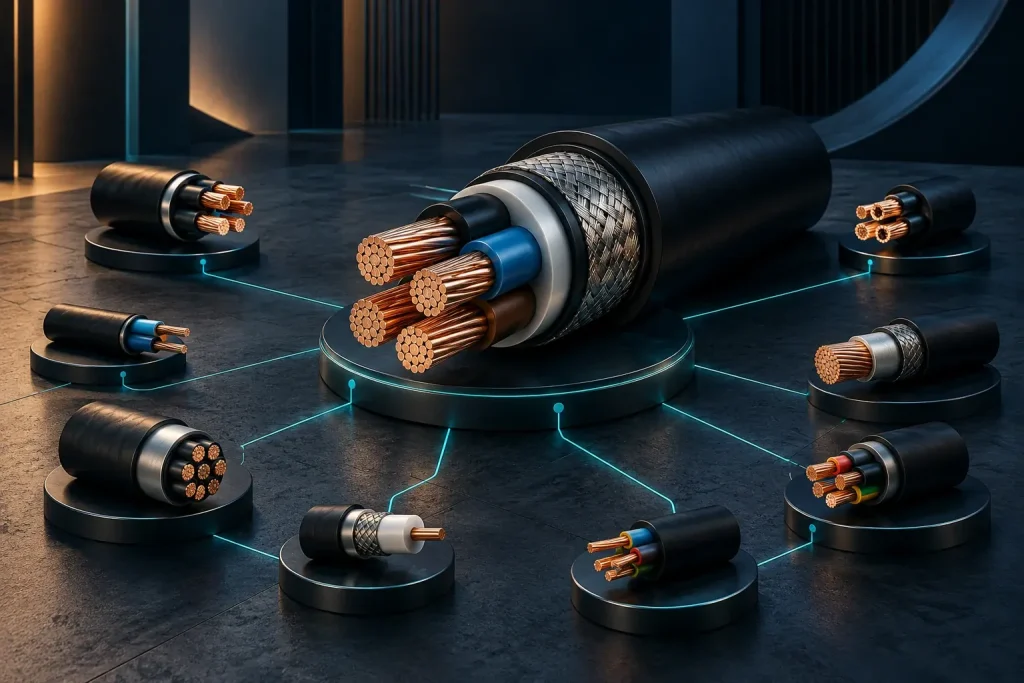
For the moving part of an elevator, being soft is not enough. A travelling cable must be chosen for the movement, the hanging length, the speed and the arrangement of power and control for that design; the fixed supply cable is a separate matter.
First say which part's cable we want
The phrase "elevator cable" can refer to the panel's incoming cable, the drive-to-motor connection, the fixed routes in the shaft or the cable that moves with the cab. These routes do not have the same function and stress. Choosing a cross-section for the supply should not be turned into choosing the core count of a travelling cable.
The elevator's electrical drawing and the documents of the elevator's maker, the panel and the drive are the basis for separating the routes. The purchase list should specify where each cable is installed, whether it is fixed or moving, and which circuits it carries. The number of stops or floors alone is not a full description of any of these routes.

What information does each route need?
| Part | Main criteria |
|---|---|
| Fixed panel supply | Load specifications, length, installation method, voltage drop and protection |
| Between the drive and the motor | The drive's instructions, the permitted length, and shield and earthing if needed |
| The travelling cable that moves with the cab | Movement, speed, hanging length, loop radius and the arrangement of the conductors |
| Control and communications | Signal type, pairs, shield and the separation needed |
| Safety circuits | The drawing and the elevator system's specific requirements |
A cable's name or the presence of a shield doesn't by itself prove the electromagnetic compliance of the whole installation. Routing, shield termination and equipment must be done to the design and relevant documents.
What extra features does a travelling cable have?
A travelling cable is designed to move with the cab. For a specific model, the maker can state the free hanging length, speed, operating temperature and loop shape. The cable may have a supporting member, power and control cores or data elements; not all models have these features equally.
In the referenced Datwyler example, the conductor class, data elements, supporting member and mechanical limits are recorded separately and the EN 50214 standard is also introduced. This example shows that choosing goes beyond counting cores; one model's numbers should not be generalized to all travelling cables.
Reference for this section: Datwyler: a sample travelling cable and its mechanical and electrical specifications
How do we bring the cab camera and network into the request?
If the cab has a camera, a network or communication equipment, the type of communication and its needs must be settled in the cable design from the start. Having a few spare cores does not guarantee that every kind of signal can be carried on them at the quality required.
Some makers offer multimedia travelling cables with defined data elements. For example, Datwyler has introduced the combination of data cable and fiber in one product. This is no permission to use a fixed-installation network cable in a moving loop; the communication element must also be chosen to suit movement and connection.
Reference for this section: Datwyler: separating the power and data elements in a travelling cable
A coordination checklist before ordering
- The location of each route and whether it is fixed or moving.
- The specifications of the panel, motor and drive and the connection diagram.
- The travel height, free hanging length and design speed for the travelling cable.
- The number and size of conductors, the control circuits and the communication needs.
- The fire requirements, the environment and the project's acceptance documents.
Substituting one model for another must be agreed with the technical lead and the system's maker. Inspecting cable in an elevator shaft is not a job for an ordinary user; for a visit or to fix a fault, get help from an authorized service and maintenance company. The softness of a is not a reason for its suitability for this use.
Information you should get from the elevator company
Before ordering, get the specifications from the elevator company or the equipment's maker; guessing the cable type from the elevator's capacity is not enough.
The type of machine and the motor's rated current or power from the nameplate, voltage and how it is supplied.
The route length from the panel to the motor and the shaft height or number of floors for the travelling cable.
The number of cores or pairs the control circuits need, and the need for a camera, phone or network inside the cab.
Maintaining and inspecting a travelling cable
A travelling cable bends and releases as the cab moves; so how it is hung and how twisting is prevented matter. The exact method must follow the cable maker's and the elevator's instructions.
- During installation, unreel the cable without twisting and let the hanging points spread the load.
- Look at the sheath in periodic inspections for abrasion, crushing or cracking.
- Tell the elevator company about any change in length, hanging point or an added circuit (such as a camera).
Frequently asked questions
Is the number of floors enough to choose the cable?
No. The real length of the route and hanging, the speed and the circuit specifications must also be known.
Can an ordinary flexible control cable be used as a travelling cable?
Only with the maker's explicit confirmation for the movement conditions of that system; the title flexible or control alone is not enough.
Are the panel's incoming cable and the motor cable the same?
They may have different requirements. Each route must be set separately from the drawing and the maker's instructions.
Products related to this topic
These products are presented for studying construction and specifications; they are not a size selection or an approval for use in a specific circuit.
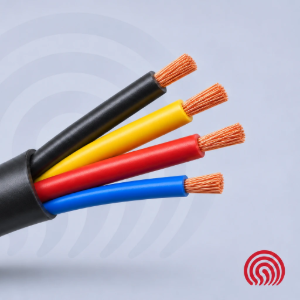
Flexible cable 4x2.5 Khorasan Electric (Afsharnejad)
A multi-core cable sample for seeing the construction; the cable type for each route is set with the elevator company.
554,000 toman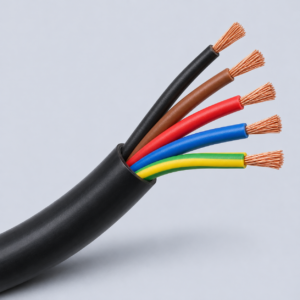
Flexible cable 5x1.5 Khorasan Electric (Afsharnejad)
A five-core sample with a small cross-section for control circuits.
433,000 toman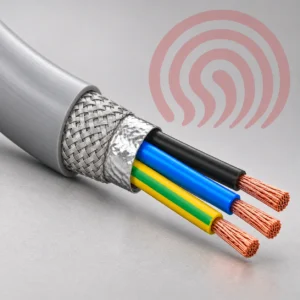
Shielded flexible cable 3x1.5 Khorasan Electric (Afsharnejad)
A sample from the same field for comparing construction, size and specifications.
350,000 tomanFlexible cable 4x1.5 Khorasan Electric (Afsharnejad)
A sample from the same field for comparing construction, size and specifications.
345,000 toman