
A pump cable must be suitable both electrically and for the installation environment. The route of a surface pump is not the same as the submersible cable of a submersible pump, and a connection underwater also needs an approved method.
Why isn't horsepower enough by itself?
A motor's mechanical power does not capture all the information about the supply circuit. To choose a cable, the voltage, nameplate current, number of phases, starting method and operating conditions matter. Two pumps with a similar rated power may have very different electrical specifications and route lengths.
In your inquiry, state the exact model of the pump and motor. Also say how many meters the route is from the panel to the equipment and what environments the cable passes through. For a submersible pump, the length of the vertical section and of the ground or overhead parts of the supply must also be included in the review of the whole circuit.
Not treating surface drainage and submersible pumps as the same
| Section or environment | Deciding factor |
|---|---|
| A dry, fixed route to the panel | Installation method, environment, current capacity and voltage drop |
| The damp area around the pump | A suitable sheath and protection of the connections for real conditions |
| The submerged section | Approval of the cable for the type of fluid, the depth and the conditions the manufacturer declares |
| The connection of the motor cable to the extension cable | Compatibility of the cables and an approved kit or connection method |
| Drive or speed control | The motor and drive instructions on the cable and the length limit |
A black sheath, the title "pump cable" or even a general mention of water resistance does not settle all submersion conditions. For a fluid other than water, special temperature conditions or a drinking-water application, approval for that same application is needed.
The data needed for sizing from the manufacturer's viewpoint
In its guide to choosing a submersible pump cable, Grundfos raises factors such as the cable length, voltage, the motor's rated current, whether it is single-phase or three-phase, the starting method and the ambient temperature. The choice of cable type also depends on the fluid and the arrangement of the motor cable.
This explanation shows how to gather the information; a table for one specific pump model should not be used for all pumps. The permitted voltage drop and the assumptions of each calculation tool must be consistent with the model and the project's regulations. For a real circuit, the result must be checked with the technical lead.
Reference for this section: Grundfos: choosing a submersible pump cable and the data needed
Check voltage drop and motor protection separately
A long route can reduce the voltage at the motor under load. The starting condition may also differ from steady operation. In a three-phase motor, imbalance or a fault in the supply must be checked alongside the cable itself. Simply enlarging the fuse or removing the protection is not a way to fix low voltage.
If the motor trips repeatedly, the cause may be in the mechanical load, the cooling, the supply or the protection circuit. Choosing the right cable is one part of the system; the motor protection and the pump's operating conditions must also be set according to the manufacturer's documents.
Reference for this section: Grundfos: motor protection and voltage drop
The underwater connection: a point not to take lightly
The motor cable and the extension cable may be joined at one point. Water ingress or an invalid connection can lead to a system failure. In the Grundfos guide as well, a faulty or unapproved connection is presented as a major cause of motor failure.
Ordinary taping or using a connection suited to a dry environment does not replace a kit and method approved for submersion. Making the connection, de-energizing, testing and protecting the route should be left to a qualified person. When ordering, send the motor cable type and the conditions at the connection point along with the pump information.
Reference for this section: Grundfos: the importance of an approved connection in a submersible pump cable
From nameplate power to approximate current
If the current is written on the pump's nameplate, that is the basis to work from. If only the power is written, the following relation can be used for a preliminary estimate for a three-phase motor:
An output power of 2.2 kilowatts, a voltage of 380 volts, a power factor of 0.8 and an efficiency of 0.8 are assumed.
I ≈ 2200 ÷ (1.732 × 380 × 0.8 × 0.8) ≈ 5.2 amperes.
The power factor and efficiency differ for every motor, and the starting current is higher than the running current. The nameplate value and the pump maker's instructions take precedence over this relation.
A buying checklist for submersible and drainage pumps
- Write the motor's nameplate current or power and the type of supply.
- Work out the total route length: the well depth plus the horizontal run to the panel.
- For the part inside the water, ask for a cable specified for submersible use.
- Seal the connection or joint with a method and material the manufacturer has approved.
- Check the motor protection and the direction of rotation at start-up.
Frequently asked questions
Is one fixed size always enough for a one-horsepower pump?
No. The actual current, length, installation method and type of pump must be known; horsepower alone does not answer it.
Is a cable suitable for outdoor use necessarily suitable underwater too?
No. Submersion and its conditions must be confirmed in the product documents.
Is only the length inside the well counted in the voltage drop?
No. The whole related supply route must be checked; the drop in the upstream sections also affects the voltage at the motor.
Products related to this topic
These products are presented for studying construction and specifications; they are not a size selection or an approval for use in a specific circuit.
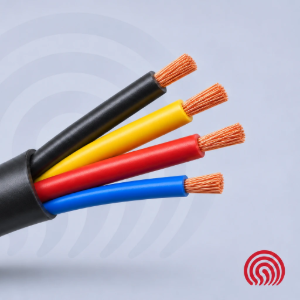
Flexible cable 4x2.5 Khorasan Electric (Afsharnejad)
A four-core sample for a three-phase pump on a dry route; the underwater part needs a special cable.
554,000 tomanFlexible cable 4x4 Khorasan Electric (Afsharnejad)
A larger cross-section for a longer route.
858,000 toman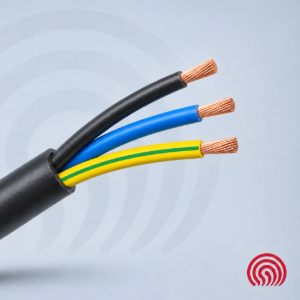
Flexible cable 3x2.5 Khorasan Electric (Afsharnejad)
A three-core sample for a single-phase pump with earth, after matching it to the nameplate.
430,000 tomanFlexible cable 3x4 Khorasan Electric (Afsharnejad)
A sample from the same field for comparing construction, size and specifications.
660,000 tomanFlexible cable 4x6 Khorasan Electric (Afsharnejad)
A sample from the same field for comparing construction, size and specifications.
1,240,000 toman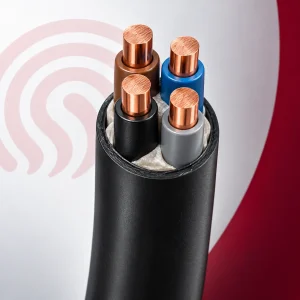
Underground cable 4x6 Khorasan Electric (Afsharnejad)
A sample from the same field for comparing construction, size and specifications.
1,355,000 toman